|
AZentertain: Arizona Gold Rush: The Lost Mine The Escalante Mine is the Iron Door Mine
The legend of the Lost Escalante Mine, also known as the Iron Door Mine, has survived for hundreds of years. Over those years, both names have been used to describe the nefarious activity supposedly conducted behind the towering Santa Catalina mountains in the 1700s. Claims of secret gold mining operations and a lost civilization that once inhabited the great Cañada del Oro basin still spur the imagination. A mineral study conducted by the U.S. Mines in 1994, though, had stated:
The real hidden treasure may have already been discovered and carted off. But some remnants of this "rich mine" in the Catalinas may still be buried away. Some of the naturally occuring gold deposits might also still be undiscovered. The very existence of a lost mine in the Catalinas has been debated for centuries as well. Read more about rediscovering the Lost Mine. Dos EscalantesThe Escalante name is somehow attached to the Lost Mine legend. There were several Escalante who lived during the time the Lost Mine was said to be in operation- sometime between 1700 and 1800. Since these two Escalantes lived about 70 years apart, this adds to the confusion. The two of them lived between the time that the first reports of newly settled Spaniards were mining in the area and after the Jesuits were expelled and the Franciscan Order took over the missions, including the nearby San Xavier del Bac in 1767. The first Escalante was Alferez J. B. de Escalante who assisted Kino from January through, at least, May 1700, according to dated letters preserved from Father Kino. 2 As a lieutenant, Juan Bautista de Escalante founded the city of Hermosillo, Mexico, also in 1700. As a military man Escalante worked closely with the missionaries to provide protection as the Spanish missionaries forged their way northward along the El Camino Real- the Royal Road- from Mexico, to Arizona and California. 1700s: Father Kino learns of rich mines near Tucson, Escalante provide protectionThe legend of the lost mine might have started when Father Eusebio Francisco Kino began his missions along the Santa Cruz River, not far from the Catalina mountains in the late 1690s. Kino came to the Americas in support of his Breve Relación of May 3, 1698. The royal cédula, issued by the King of Spain, was used to convert the natives and promise that they would not be forced to work in the mines if they converted to Christianity. Kino's
As Kino made this way up through present-day Arizona, called Pimeria Alta, he brought along the Spanish military, settlers and lots of livestock. Some of the cattle and wild horses roaming Southern Arizona today are decended from Kino's initial herds. When Kino helped lay the foundation for the San Xavier del Bac mission near present day Tucson, in 1702, he described in his diaries about
According to several legends associated to this period, the Spanish Jesuits forced the local natives into slavery to mine the gold from the Catalinas among other areas. The details, though, change with the different versions.
History does record a Captain Juan (Baupptisa) Baustita de Escalante who served as governor of Sonora in 1700. This Escalante was a military man, not a Jesuit priest. There are no records of Capt. Escalante being involved with any mining ventures, but Capt. Escalante did assist Kino in routing out rebellious Apaches that threatened the missions and settlers, according to Kino's letters. Escalante often would capture Indians and turn them over to the Fathers. In one instance, he helped Kino to rescue an Indian prisoner from death. In his journal, Kino included a 1701 letter from Escalante about his attack against the Apaches:
Whether this Captain Escalante had a secret mining operation in the Catalinas, it has not been recorded. But, it is most likely that this is the Escalante that the mine was named. No mention is made about what happens when the edit expired 20 years after the natives converted. 1760s: Father Escalante the FranciscanThere was a Father Silvestre Vélez de Escalante, a Franciscan missionary and explorer who helped lead expeditions throughout the West in the 1776. But, this was years after the Jesuits left San Xavier del Bac mission in 1767. This Father Escalante may have passed through the area, but there are no records of this Father Escalante's visit to the Tucson area or any mining activities either. In an often referenced article, John D. Mitchell says the Escalante mine was worked for many years by Father Silvestre Velez de Escalante, a Jesuit priest who at the time was an assistant to Father Eusebio Kino. In a 1952 magazine article, he further says that according to church records, the Escalante Mine was in full operation in 1767 when the Spanish King Charless III issued the edict expelling the Jesuit Order from Spain and all possession. To add to the confusion, author John Mitchell states that:
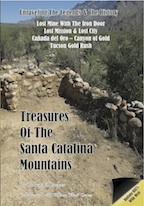
If this were true, the mine had to be named after the first Captain Escalante since Silvestre Escalante didn't cross Arizona until 1776. Those church records haven't been located. But, Mitchell also stated in the same article that the mine had "is believed to have been found and worked for many years by Father Silvestre Velez de Escalante, a Jesuit priest who at one time was assistant to Father Eusebio Kino at Mission San Xavier del Bac near Tucson. Silvestre Escalante was a Franciscan and went on his expedition over 65 years after Kino died in 1711. So, was the Escalante mine found by either Escalante- hence the Lost Escalante mine. Or, was it a mine by the name Escalante that became lost? As time passed, the whereabouts of the Spanish mining operation had faded from memory, except through the legends until it revived during the Arizona Gold Rush in the 1880s. "Treasures of the Santa Catalinas" is NOW Available on Amazon.com.Read sample chapters from the new book "Treasures of the Santa Catalina Mountains" with over 600 pages and more than 1,200 footnotes to the source materials. NEXT: Rediscovering the Lost Mine during the Arizona Gold Rush of the 1880sLost Mine of Santa Catalina MountainsAZentertain Home© 2007-2017 AZentertain.com. All rights reserved. Entertainment Magazine network. BZB Publishing, Inc. |
 In one version, the mines were managed by one of Kino's assistants named a Father Escalante.