AZentertain: Arizona Gold Rush
The Lost Iron Door Mine of the Santa Catalina Mountains
By Robert E. Zucker
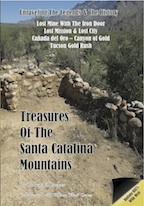 This
information is found in the comprehensive book on the legends and
history of the Catalina Mountains– "Treasures of the Santa Catalina
Mountains," available on Amazon. Read and download a free sample PDF.
This
information is found in the comprehensive book on the legends and
history of the Catalina Mountains– "Treasures of the Santa Catalina
Mountains," available on Amazon. Read and download a free sample PDF.
The legend of the
Iron Door Mine of the Santa Catalina Mountains, north of Tucson,
Arizona is one of those stories that may have some basis in fact and
history, according the extensive recent research.
While tales of buried of a lost mine and hidden treasure in the Santa Catalinas have
been passed on for generations, there are no archaeological excavations
in the area to support the legends, yet.
However, there have been pieces of
evidence and documentation to point to some possibilities that could
have spawned the Lost Mine with the Iron Door legend.
The Santa Catalinas have been prized by
early American pioneers for its placer deposits of gold and silver,
often found in ledges along the Canyon of Gold (Cañada del Oro).
The Iron Door Mine legend alludes to the early Spanish settlers in the
late 1600s and early 1700s who may have discovered the hidden mineral riches, mined them and buried them somewhere in the
Santa Catalina Mountains.
Extensive research by local Tucson author Robert Zucker and numerous mining claims staked by prospector Flint Carter uncovered substantial documentation of valuable
minerals in the Santa Catalinas Mountain range and insights into the actual story about the Iron Door Mine.
 Some
of the most complete evidence about the existence of the Iron Door
Mine, both legend and historical documentation, has been published in
Zucker's 2014 edition of "Treasures of the Santa Catalinas." Read chapters and download a free sample edition
of the book and order the complete version on Amazon.com
Some
of the most complete evidence about the existence of the Iron Door
Mine, both legend and historical documentation, has been published in
Zucker's 2014 edition of "Treasures of the Santa Catalinas." Read chapters and download a free sample edition
of the book and order the complete version on Amazon.com
A new book about
the Iron Door Mine is in preparation for publication. Contact Robert Zucker to pre-order "The Iron Door Mine."
Video Presented by KGUN-TV Tucson, Arizona. Pat
Parris interviews Robert Zucker about the Mine with the Iron Door legend
on "Absolutely Arizona" hosted by Pat Parris. June 2, 2025.
https://youtu.be/jsklGMlHj8s?si=dXOEknKToGkqr79e
These chapters are from the book, "Treasures of the
Santa Catalina Mountains" which explores the Mine With the Iron Door
legend and other historical events that occurred in the Catalina
Mountains.
The Legend of the Lost Mine
Claims of secret mining operations, a
lost civilization that once inhabited the great Cañada del Oro basin,
the gold rush of the 1800s and the famous Mine with the Iron Door book
and movie still spur the imagination.
During the late 1880s through the 1930s,
countless articles in the Arizona newspapers published stories
of people who claim to have found either a lost city, the lost mine or
other great treasures in the Santa Catalina Mountains, north of Tucson, Arizona.
But, the exact location of either the lost city or lost mine with the Iron Door has never been fully disclosed or documented.
Either it has never been found, or the
secret has been taken to ones grave.
The real
hidden treasure may have already been discovered and carted off. But
some remnants of this "rich mine" in the Catalinas may still be buried
away. Some of the naturally occurring gold deposits may still be
undiscovered.
Today's technology can define once
and for all whether the legends have any substance using metal
detectors, ground penetrating radar, re-exploration of the area to
unravel the mystery.
The Mystery of the Lost City & the Lost Mine
There are actually two mysteries.
The legend of the Lost City
in the Santa Catalinas is in a different location from the lost mine,
made famous during the 1920s as the Iron Door Mine, or Lost Escalante Mine. This section examines
the Lost Mine legend in detail.
Some of
legends name an Escalante who was an associate of Father Eusebio Kino,
the missionary who founded Jesuit missions from Mexico through Arizona
and California. This time period is about 1702.
The legend says that the mine was located deep within the Santa Catarina mountains somewhere along the Cañada del Oro.
Accordingly, this Escalante
had worked this mine using the local natives as slaves in the mines.
There was a Sgt. Escalante who accompanied Father Kino through some of
his journeys, but he was not a miner (although he did later retire to
become Mayor of a Mexican mining community).
But, archeologists have confirmed there was some type of
settlement near the Cañada del Oro that sustained its inhabitants and may also have served as
a mission. This may be the long, lost city of the Catalinas, called Santa Catalina.
The mine produced vast quantities of gold- much of which was taken to Spain.
When the Jesuits were
expelled in 1767, they left behind their riches. The bars of gold were
hidden behind an "iron door." Thus, the Mine with the Iron Door.
Areas deep in the interior of the
Cañada del Oro basin, could have been in operation up until the time the
Jesuits were expelled in 1767, or later, from Pimeria Alta- as this
land was called by the Spanish. The U.S. Bureau of Mines conducted a
mineral study of the Santa Catalina and Coronado National Forest and
reported that:
"Gold
placering in Canada del Oro ("gold gulch") was undertaken in the
northern Santa Catalina Mountains by Spaniards as early as the
mid-1700's. The canada drainage flows northward from its headwaters in
the central Santa Catalina Mountains through about 9 mi of the Forest
Unit, then crosses the Unit boundary and turns south, flowing parallel
to and mostly outside of the Forest Unit." (1, p. 24).
1700s: The Escalante Mine is the Iron Door Mine
The legend of the Lost Escalante Mine, also known as the Iron Door Mine, has survived for hundreds of years. Read more about the Lost Escalante mine.
1880s: Rediscovering the Lost Iron Door Mine
After more
than one hundred years, the mine became lost in memory, except for a few
remembrances and newspaper articles to keep the legend alive. Read
about the rediscovery of gold bearing quartz in the Catalinas that
re-energized the hunt for the Lost Mine during the 1880's.
"Treasures of the Santa Catalina Mountains" is
available in print and Kindle on Amazon.com
Content on this
web site about the Iron Door Mine is from the book "Treasures of the
Santa Catalina Mountains" containing over 400 pages and more than 1,000
references.
Read select sections and download a FREE PDF sample from the book "Treasures of the Santa Catalinas: Unraveling the History and Legends of the Iron Door Mine, Lost City and Lost Mission," by Robert E. Zucker.
A new book about
the Iron Door Mine is in preparation for publication. Contact Robert Zucker to pre-order "The Iron Door Mine."
"The Mine with the Iron Door: A Romance" by Harold Bell Wright (1936)
Author Available to Share Legends and History
Robert Zucker, author of "Treasures of the
Santa Catalina Mountains," is available to speak to your group or
organization about the history and legends of the Catalina Mountains,
including a presentation on the famous Iron Door Mine legend of the
Catalinas. To arrange a presentation book,
email publisher@emol.org