|
AZentertain: Arizona Gold Rush: Gold
Mining for gold and silver in the Santa Catalinas and the Canyon of Gold
Download a
free sample of "Treasures of the Santa Catalina Mountains" and purchase the full print or Kindle version
on amazon.com. Read samples chapters from the book below.
By Robert Zucker
Contributed by William Flint Carter
Gold trapped in quartz is a valuable commodity that helped spur the Arizona Gold Rush of the 1880s. Quartz is an abundant mineral in the Santa Catalina mountains, north of Tucson.
Americans came to the Catalinas at
the end of the California Gold Rush. Waves of settlers homesteaded on
the northside of the Catalina mountains. They dug for precious metals
like gold, copper and silver.
While much of the gold has been hauled away
from the mountains, fortunate prospectors can still find gold and quartz
bearing gold and silver, in select areas of the mountains.
"Treasures of the Santa Catalinas"
is NOW Available on Amazon.com.
Learn the legends and
history of the Santa Catalina Mountains- including the Tucson Gold
& Silver Rush, the Iron Door Mine, and Buffalo Bill Cody's mine.
Read sample chapters, and download free PDF sample from the new book "Treasures of the Santa Catalina Mountains" with over 600 pages and more than 1,200 footnotes to the source material.
Quartz bearing gold leads the discovery
"The mine is one of the few in the Santa
Catalina Mountains which has produced any significant quantity of
auriferous ore. Otherwise known as Fools Gold," from 1881 to 1906,
18,666 st of auriferous quartz vein were mined." (A41)
The report says that "there are an
estimated 85,200 st of indicated resources of auriferous vein material
along the full strike length" (A41). The report suggests that it was not
economically viable to leach out the remaining gold. That was when the
mid-1994 price of gold was $387 an ounce. 1
As early as January 1882 adventurous developers were building roads and railroads to haul out the newly discovered gold ore:
"another railroad project is on foot which
promises to add to the importance of Tucson and bring our city in direct
communication with the rich mines of the Santa Catarinas." 2
Dr. K. Kane spearheaded the movement to
build a three foot guage road along the route now traveled by the Santa
Catarina stage line round the point of the mountains to the Oracle mine.
In the vicinity, ex-Tucson Maor R. N. Leatherwood had a large ranch. At
that time, the Santa Catalina mountains were called the Santa
Catarinas.
"From the Oracle camp the road will be run
by the most feasible route to the American Flag mine; from the American
Glag to the camp of the Santa Catarina Copper; from that point, over the
road already built by the Santa Catarina Company to the San Pedro
valley."
The road was expected to continue until it
"reaches the Atlantic & Pacific" and that it would open up one of
the richest mineral sections in the territory. 2
But, by February 1886, the old Apache copper
smelter in the Santa Catalinas had closed because of financial
difficulties. Although, the Southern Belle gold mine, which started a
few months earlier has already shipped about $7,000 worth of gold. 3
It wasn't until December 1887, that "work
has again started upon the well-known American Flag mine and things are
likely to boom in the Santa Catalinas," according to the Mohave County
Miner reporting on an article in the Tucson Citizen. "Mr. Armstrong, who
represents the syndicate bonding the property has ten men employed
taking out such ore as will prove available for shipment and the recent
outlook of the property is an extremely favorable one." 4
By November 1900, the Cañada del Oro river was being worked on for placer and lode gold mining.
"The Canada del Oro gold mines or field,
situated 35 miles from Tucson, on the north foothills of the Catalina
mountains, comprise over 400 acres, are now being worked with an average
of $14 free milling ore, with large veins of low grade ore. Its name
was given the Canyon of Gold. The owners are Tucson citizens." 5
Even by 1901, gold was discovered in the Cañada del Oro:
"Rich gold strikes are becoming frequent in
Arizona. They are so numerous and so rich that some hesitancy Is made
In recording them for the public interest It might be thought they were
over drawn, says the Citizen, but if there are those who entertain
doubts, all that is nessary to dispel a disbelief Is to examine the
specimens referred to, or, better still, visit the mines themselves.
The latest strike comes from Canada del
Oro. Mr. Charles Bauer, at a depth of ten feet has uncovered a 2 1/2
foot ledge of very rich gold reck. The ore has the appearance of
honey-combed rock having ben tilled with melted. gold; when broken the
particle1 of rock are held together by wire gold, and is, in fact
nearly, pure. Mr. Bauer does not exaggerate his property, being content
to say that he has taken out only 100 pounds of the precious rock. The
claim is known as the Ella, and adjoins the group of mines lately bonded
by hlmself and Mayor Schumacher, and Is also adjoining the mines owned
by Dr. Mattas of this city.
The Ella Is the personal property of Mr.
Bauer, who has been very successful in mining throughout Colorado as
well as Arizona. The Canada del Oro district is one of the most,
promising mining fields in Arizona, and the public may look for more
cheering news from that section as development work progresses." 6
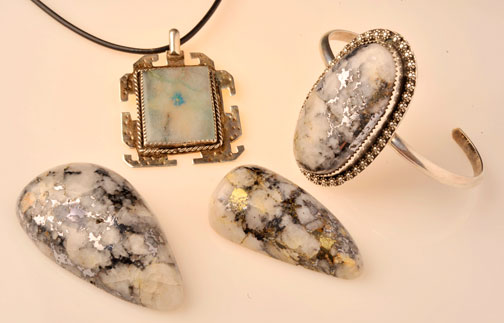
- Photo above: Cody Stone showing the detail of the gold in the quartz.
Read the original newspaper articles digitized by the Chronicling America
Newspaper Project, a National Endowment for the Humanities project of
the Library of Congress. Select a link to open the newspaper page in a
new window. Choose from several viewing formats from PDF to JPG.
1. "Mineral Appraisal
of Coronado National Forest, Part 5" Mineral Land Assessment, 1994.
U.S. Department of the Interior, Bureau of Mines, Santa Catalina-Rincon
District.
2. Tombstone Epitaph, January 23, 1882, image 6
3. Tombstone Daily Epitaph, February 20, 1886.
4. Mohave County Miner, December 24, 1887.
5. Arizona Republic, November 13, 1900, image 1
6. Arizona Republican, August 12, 1901, "STRIKES IN PIMA COUNTY Glittering Yellow Metal Found at Canada Del Oro.
Cody Stone is mined and designed as jewelry grade gold and silver in quartz from the mountains of the Santa Catalinas.
Cody stone specimens and hand made items are
on display at the Oracle Inn Steakhouse & Saloon in Oracle,
Arizona. Get a tour of the area, see artifacts of the Iron Door Mine and
Southwest, and mine for gold with Flint Carter.
© 2005-2011 AzEntertain.com. Entertainment Magazine. All rights reserved.
|
 Jewelry grade gold and silver in quartz from Arizona